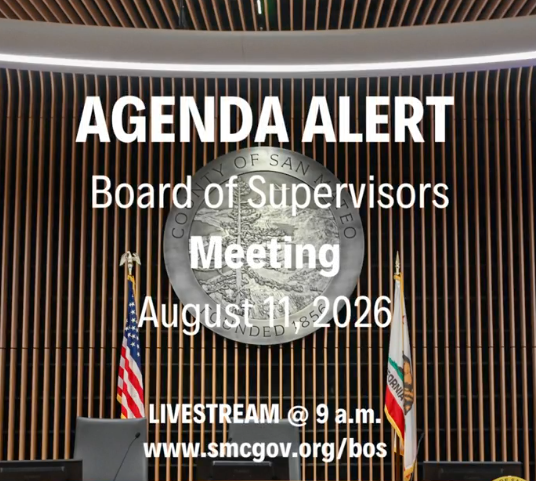
San Mateo County could become one of the first local governments in the nation to require permits for commercial humanoid robots when the Board of Supervisors takes up the issue at its Tuesday, Aug. 11 meeting at 9 a.m.
The resolution, listed as File #26-627 on the board's agenda, would direct County Executive Mike Callagy and legal staff to draft a formal ordinance regulating untethered, autonomous or semi-autonomous humanoid robots in commercial spaces. It would not enact a permit requirement immediately.
Supervisor Ray Mueller introduced the measure. He told the Palo Alto Daily Post in an Aug. 7 interview that he got the idea after discussing AI's workforce impacts and hearing about humanoid robots already deployed in Asia.
"They're on their way here," Mueller said.
The proposed framework would cover robots in hospitality, logistics, security, facilities maintenance, customer service, public information and emergency response support. Applicants would need to show their robots meet ADA and sanitation standards, carry emergency kill switches and have no active recalls or patterns of catastrophic failure. Every permitted robot would require a trained, on-site human supervisor at all times.
Mueller, who serves on the county's Emergency Services Council, wants permit fees to fund specialized firefighting equipment for lithium-ion battery "thermal runaway" fires, which generate heat after ignition beyond what standard fire trucks can handle. He also wants the county to track whether robot deployments cause layoffs, warning that displaced service workers could shrink the tax base while demand for social services grows.
The county's own board memo acknowledges that no comprehensive regulatory framework exists at any level of government for humanoid robots in publicly accessible spaces. Mueller expects the state or federal government to eventually step in but argues San Mateo County should act first to demonstrate that permitting fees are justified so local taxpayers aren't stuck with the bill for new equipment.
Mueller has pushed automation policy before. In January 2024, he authored a resolution, passed 5-0, establishing that AI should supplement rather than replace county employees. In April 2025, supervisors unanimously required departments to estimate potential AI job displacement before adopting automation software.
The issue has local urgency. Robotics firm 1X Technologies opened a 58,000-square-foot factory in neighboring Hayward in May, targeting production of up to 10,000 humanoid robots annually, and according to Hoodline has plans for an expansion facility in San Carlos, inside San Mateo County.
The county posted the agenda on its official X account Monday, Aug. 10.
Residents can find meeting details at smcgov.org/bos.